null
888-686-6673 888-686-6673
844-305-5023 844-305-5023
877-316-6673 877-316-6673
Moore Brothers Blog

Moore Brothers Blog

Bérèche Pere et Fils

Bérèche Pere et Fils

Raphaël and Vincent Bérêche The original Bérêche estate is centered around 2.5 hectares of vines established by Leon and Albert Bérêche in 1847. Successive generations expanded the property, and today there are a total of 9.5 ha in and around the communes of Craon de Ludes, Ormes, Trépail, and Mailly, all in the Montagne de Reims, as well as the area around Mareuil-le-Port on the left bank of the Marne. The 0.15 ha Mailly parcel, acquired in 2012, is their first Grand Cru vineyard. Since joining their father Jean-Pierre in 2004 and 2008 respectively, Raphaël and Vincent Bérêche have risen to the head of the class of Champagne’s corp of elite grower producers. Most of their wines are sold directly to private customers, who drive from Brussels and Paris and London to pick up their six or twelve bottle allocations at the winery in Craon de Ludes. Almost all the rest goes to Michelin-starred, like Gérard Boye

Biodynamic Farming at Domaine Barmès-Buecher

Biodynamic Farming at Domaine Barmès-Buecher

greg Greg Moore

Thou shalt not muzzle the ox when he treadeth out the corn. — Deuteronomy 25:4 A spring visit to Domaine-Barmès-Buecher where we come across Mathieu, Maxime Barmès' best friend who is plowing the domaine’s Hengst Grand Cru parcel. Later we return to the vineyard with Geneviève Barmès to see the results, and the difference careful farming can make. Spring déchaussage at Domaine Barmès-Buecher by “Ursus” (the horse), Mathieu (Maxime Barmès' best friend), and “Pikachu” (the dog).

Wine in the "Old World"

Wine in the "Old World"

wine David Moore

I’d just completed a two-hour drive from Orly (with a stick shift, mind you — that vehicle would never be the same) after an eight-hour flight from Philadelphia — my first trip to France. I was beat, but as I pulled up to the front gate at Philippe Poniatowski’s Clos Baudoin, and stepped out of the car, I was struck by the familiarity of the place. I’d opened hundreds bottles that grew on this estate, and had drunk quite a few myself. A deep breath was all it took to recognize the“Clos,” even though I’d never been there. Philippe (now, deceased), was in his 70s at the time, and I was a young “know-it-all” back then, but he did all he could to guide me to an understanding of wine in the “Old World.” He was patient with me — no simple task in those days…some might argue that hasn’t changed…but I digress. On the map above, you see many places carefully mapped out that show the boundaries between one wine region and another. The concept of wine as having a distinct, ge

Shipped at 56 (why it's important)

Shipped at 56 (why it's important)

wine David Moore

So that big truck pulled up outside of Sergio Germano's winery, fully refrigerated at 56° (13.33° Celsius, for those “in the know”). It was the first time I'd seen one of the reefer trucks in Europe. After a whole lot of years working in wine, it's unbelievable that this isn't the “norm.” On this same day, a number of (much smaller) delivery vans pulled in to pick up smaller amounts of wine, and none of them were refrigerated, let alone air-conditioned — and this was in June. The small vans were apparently picking up from a number of wineries in Barolo, so one has to assume that a lot of wine was sitting in these vans for some time before they got to their initial destination. One hot July afternoon outside of Domaine Ampeau, I saw a flat-bed with dozens of cases of expensive Burgundy sitting outside the cellar. It had come to pick up 10 cases from the domaine. It was in the low 90's temperature-wise. Who knows how long those wines had been sitting there, or how mu

The Math of Grapes

The Math of Grapes

wine David Moore

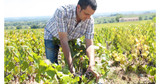
Patrick Brunet of Domaine de Robert, farms roughly 2,500 vines per acre by hand In wine production, oak barrels (see here for more on this subject) are the second largest expense after grape purchases, unless, of course you already own the grapes, having grown them yourself. In industrial “winemaking,” where a company needs to fill its “brand position” in the marketplace with many multiples of thousands of cases, this is rarely, practically never the case. Whether you’re “Cupcake Vineyards,” and buying grapes or ready-made “wine” on which you’ll slap your label (or a multi-national, publicly-traded marketing corporation most known for luggage that does the same), the “raw material,” grapes, are one of your largest expenses. This brings us to farming. Before we get started down that road, let’s first establish how things work with our producers; 99.5% of them farm their own vineyards, and do so sustainably. Most are fully “organic,” some are "certified" in their respe

Beaujolais, Oui!

Beaujolais, Oui!

greg Greg Moore

Greg Moore at the Tasting Table Often maligned, Beaujolais, from all of its many “places” produces some of the most versatile and compelling wines at Moore Brothers. Greg Moore offers a heartfelt, full-throated defense of one of France's most iconic wines: allowfullscreen="allowfullscreen">

Domaine des Cretes

Domaine des Cretes

Jean-François and Sylvain Brondel in the winery Jean-François, Sylvain, and Martine Brondel represent the third and fourth generations of their family to produce fine Beaujolais at Domaine des Crêtes. There are ten hectares of Gamay Noir, grown on a mix of yellow limestone, clay, and a little blue granite; and one hectare of Chardonnay for the Beaujolais Blanc and Crémant de Bourgogne. The “Cuvée des Varennes,” which is always one of the top wines of the Beaujolais appellation, comes from a parcel of seventy year-old organically farmed vines. In 1998, Domaine des Crêtes was a founding member of “Terra Vitis,” now an association of growers throughout France who practice sustainable viticulture. The farming is natural, with traceability checks carried out by an independent organization operating under the "Terra Vitis" guidelines which were established to protect groundwater and preserve the natural condition of the soils. I

Domaine Le Roc des Anges

Domaine Le Roc des Anges

Marjorie and Stéphane Gallet in Montner Marjorie Gallet was twenty-three years-old (and recently married to her young winemaker husband, Stéphane), when she came upon old vineyards near her home. Many of these sites were abandoned, and most were available for sale. Borrowing money from her friends, she founded her Domaine Le Roc Des Anges — the name being a play on the rocky schist and quartz soils of the area. With her first vintage in 2003, she established herself as a “superstar” in the Roussillon, producing wines of dense complexity in a region most known for mediocre, overcropped “cheap wine.” “Old vines, old soil. I’m the only young thing at the domaine,” Marjorie told an interviewer shortly after she created Domaine Le Roc des Anges. We are extremely privileged to have a relationship with Marjorie and her husband, who joined her at the domaine in 2008 after spending ten years making wine at Domaine du Mas Amiel in nea

Robert Ampeau

Robert Ampeau

greg Greg Moore

Robert Ampeau in 2003 (photo: Greg Moore) Robert Ampeau was a legendary figure, and an admired colleague of the most important producers in Burgundy, including Aubert de Villaine, Lalou Bize-Leroy, Dominique Lafon, and Hubert de Montille, whose cellars all contain Ampeau wine. Ruth Reichl, the last Editor-in Chief of Gourmet magazine, recorded the impression that Ampeau made on other producers in her 1998 memoir, Tender at the Bone, in which she recorded her visit to the Volnay producer Hubert de Montille, accompanied by the wine merchant, Kermit Lynch. Kermit had brought along a bottle of one of Ampeau’s wines (label removed) “to see what he really thinks.” “There is sunlight in the glass,” de Montille said finally, “much sunlight. It is from a very good year…what can it be?” When Kermit told him what it was, de Montille cried, “But I have this wine in my cellar!” He turned eagerly to Kermit and asked, “Did Ampeau sell

Tannins In Wine

Tannins In Wine

greg Greg Moore

What are “tannins?” In this video from an in-store tasting at Moore Brothers Wine Company, Greg Moore explains tannins in wine; what they are, why they are, and how tannins shape our perception of wine. What are “tannins” - Video explaining tannins in wine.

You are currently shopping in the store!

If you want to shop from one of our other locations shown below, your current shopping cart will be cleared - you may only shop and checkout from a single location at a time.

Select Your Location

Please choose the store below which best suits your interests. Thank you for visiting!

For in-store pickup from our Pennsauken, NJ shop (10 minutes from Center City Philadelphia), or delivery to New Jersey addresses.

For in-store pickup from our Wilmington, DE shop.

For delivery to your door in NY, PA, DC, CT and 32 additional states, or in-store pickup from our Industry City Brooklyn shop.