Moore Brothers Blog

Moore Brothers Blog: producers

Corte Gardoni

Corte Gardoni

winegrowers Greg Moore

Andrea, Gianni, and Mattia Piccoli The late, Gianni Piccoli was as stubborn as he was modest and self-effacing, with no interest in following the easy paths to guaranteed market share if they mean compromising his principles. He and his sons Mattia, Andrea, and Stefano simply made the best wine in Bardolino. Which is how they find the best customers. Corte Gardoni was established in 1980, when Gianni decided that his beautiful grapes–carefully farmed at low yields on the stony slopes of the moraine in Valeggio sul Mincio–would no longer be sold in bulk, to be blended anonymously in the vats of industrial wineries like Bolla and Folonari that still dominate Bardolino. Building a winery was a risky undertaking in a region that had such little prestige, but Gianni Piccoli never looked back. Today, under the direction of his son Mattia, Corte Gardoni supplies the finest Bardolino and Custoza to nearly every Michelin starred restaurant in Italy.

Marjorie & Stéphane Gallet

Marjorie & Stéphane Gallet

winegrowers Greg Moore

Marjorie and Stéphane Gallet in Montner These wines come from selected parcels grown in the stony, red clay soil of Rivesaltes, and are made at the Cave Cooperative de Rivsaltes under the direction of Stéphane and Marjorie Gallet of Roc des Anges. By helping the cooperative’s growers understand the benefits of sustainable farming, limited yields and harvesting before the grapes are over mature, the Gallets are hoping to raise the general quality of wine in their appellation. It’s demanding work, but the results are producing the finest wines ever made at the Cave Cooperative de Rivesaltes.

Giovanni Almondo

Giovanni Almondo

winegrowers Greg Moore

Domenico Almondo The Almondos have grown grapes in Roero for more than three centuries, but it was Domenico’s father, Giovanni Almondo, who was the first to bottle a tiny quantity of wine. The estate comprises six hectares of Arneis, the noble white variety of Piemonte; four hectares of Nebbiolo for the Roeros; one-and-a-half hectares of Barbera; and a tiny parcel of Brachetto, for the delicate, sweet sparkling red Mosto Parzialmente Fermentato “Fosso della Rosa.” With the day-to-day operations in the hands of Domenico, who is both an uncompromising perfectionist in the vineyard and an immensely talented winemaker, the estate is widely regarded as the top producer in Roero.

Fabrice Gasnier

Fabrice Gasnier

winegrowers Greg Moore

Fabrice Gasnier in Chinon When we last saw Fabrice Gasnier at his beautiful home in Cravant-les-Coteaux, he had just completed a five-year transformation of his 24-hectare estate to biodynamics; the agricultural discipline based on a series of lectures by Rudolph Steiner titled The Spiritual Foundation for the Renewal of Agriculture. Steiner was an Austrian philosopher active in the late nineteenth and early twentieth centuries who is best known today as the founder of the Waldorf Schools. It would be easy to describe biodynamics as something like “Organic Plus,” but more than simple labor-intensive organic farming, biodynamics includes a strong belief in interdependence among the “forces” of Earth, Life, and Cosmos. “In the past,” Fabrice says, “we would have sprayed fungicide in the vineyard whenever we had cold, wet weather.” Scooping up a handful of clay-calcareous soil he smiles and says, “But I don't think that way anymore. Now when I see mildew in the vines, I see it as

Three Wine Company

Three Wine Company

winegrowers Greg Moore

>Matt Cline in the old vineyards of Oakley Along with Joel Peterson at Ravenswood in Sonoma, and Paul Draper at Ridge Vineyards in Santa Cruz, Matt Cline was one of the original champions of single-vineyard, old-vine Zinfandel. Before establishing Three Wine Company in 2006, Matt was a founding partner of Trinitas Cellars (which he sold in 2006), and had worked with his brother Fred at Cline Cellars. Along the way, he has quietly produced some of the most dramatic red wines ever made in California, mostly from grapes purchased under contract with third and fourth generation farmers of ancient parcels in Oakley and Lodi in Contra Costa County.

Château Brûlesécaille

Château Brûlesécaille

winegrowers Greg Moore

Jacques Rodet No doubt Château Brûlesécaille, which was classified a Cru Bourgeois in 1868, would be better known today if the wine were sold on the Place de Bordeaux. But Jacques and Martine Rodet, who took charge of the family estate in 1974, prefer to sell their wine directly, in mutually rewarding personal relationships like the one that established Château Brûlesécaille at “Les Trois Marches” in Versailles more than thirty years ago, and the one I hope will continue long into the future. The 26-hectare estate lies on an elevated croupe of gravelly clay limestone overlooking the Dordogne in Tauriac, one of the most privileged locations in the Côtes de Bourg. Of special interest is that many of the vines are more than seventy years old, having escaped the ravages of the terrible freeze of February 1956, which destroyed nearly three fourths of the vines on the Right Bank. Stéphane Beuret, the brilliant enologist who also makes the wine at Château Larroque, supervises the winema

Domaine Etienne Daulny

Domaine Etienne Daulny

winegrowers Greg Moore

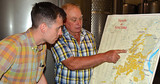
Etiènne Daulny showing the map of his vineyards to Terry Moore If you ask Bertrand Daulny, the winemaker and chef de cave at this impeccable 15-hectare estate in Verdigny, why his elegant Sancerres are always counted among the finest white wines of the middle Loire Valley, he’ll point you to his older brother Etiènne, who grows the grapes. “Il s’agit de la vigne; pas de la cave.” (“It’s all about the vineyards; not about the cellar.”) But if you ask Etiènne, he’ll point you right back to Bertrand. “We grow healthy grapes, but Sauvignon Blanc is a capricious variety, with aromatics that depend on great cellar work.”

Domaine Combier

Domaine Combier

winegrowers Greg Moore

Ghislaine and Laurent Combier Maurice Combier purchased the Domaine's original 10 hectares of vines north of Pont-de-l'Isère in 1962. During the 1960s, he had an allergic reaction to a chemical used in fruit orchards and vineyards to fight plant diseases. In an experiment, he adopted organic farming in half of his property to learn the processes necessary to keep the fruit healthy, naturally. By the 1980s, the entire estate was transformed to organic farming, and the family sold their fruit to the cooperative at Tain l'Hermitage. In 1990, when son Laurent finished oenology school, they left the cooperative and have made their own distinctive style of Crozes-Hermitage ever since. Certified biodynamic farming, low yields, hand-harvesting,and rigorous selection are at the heart of his graceful wines.

Azienda Agricola Kuenhof

Azienda Agricola Kuenhof

winegrowers David Moore

Peter and Brigitte Pliger began producing wines under the Kuen hof name in 1990. Their six hectares of land–located just outside the town of Bressanone, a short distance from the Austrian border–have been in the family for two hundred years and planted to vines since the twelfth century.Perfectly situated at 600 meters above sea level for the traditional varietals, Veltliner, Sylvaner, Riesling and Traminer, the schisty soils produce nuanced, lengthy, highly aromatic wines. The term, Eisacktaler, is the German name for this former Austrian region known as the Valle Isarco in Italian.Peter practices his own form of sustainable agriculture, combining organic and bio-dynamic principles along with his Zen training to find the best mix for each growing season's need. The winemaking is geared towards preserving the vibrant minerality and structure his soils provide resulting in wines that are completely dry, with a complelling richness and complexity. His total production is fewer than 3,000

Chateau Martinat

Chateau Martinat

winegrowers Greg Moore

Lucie Donze in her cellar Lucie & Stéphane Donze are the owners of this small estate in the Côte de Bourg. Both were successful in their respective businesses; Lucie was a landscape architect, and Stéphane was in maritime transport. In 1994 they bought the old vineyards and run-down farmhouse of Chateau Martinat with borrowed money. Three years of planning went into the career change. There are only about 24 acres (American) under vine. These hold the Merlot and Cabernet vines which were planted in the late nineteen fifties. The Malbec plantings are much older. The farming is “Lutte Raisonée,” with grass between the rows, and the harvests are by hand.

You are currently shopping in the store!

If you want to shop from one of our other locations shown below, your current shopping cart will be cleared - you may only shop and checkout from a single location at a time.

Don't Change Store

Select Your Location

Please choose the store below which best suits your interests. Thank you for visiting!

New Jersey Pickup & Shipping to NJ

For in-store pickup from our Pennsauken, NJ shop (10 minutes from Center City Philadelphia), or delivery to New Jersey addresses.

Delaware In-Store Pickup

For in-store pickup from our Wilmington, DE shop.

NEW YORK/DIRECT SHIPPING Pickup & Shipping to 36 states

For delivery to your door in NY, PA, DC, CT and 32 additional states, or in-store pickup from our Industry City Brooklyn shop.