null
888-686-6673 888-686-6673
844-305-5023 844-305-5023
877-316-6673 877-316-6673
Moore Brothers Blog

Moore Brothers Blog: Meet the Winegrowers

Biodynamics and Sparkling Wine:

Biodynamics and Sparkling Wine:

learn Greg Moore

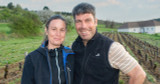
Sophie, Maxime, and Geneviève Barmès in the Clos Sand (photo: Greg Moore) The late François Barmès wholeheartedly embraced the Austrian philosopher Rudolph Steiner’s belief in the interdependence of the forces of life, earth, and the cosmos. So in 1995, in order to undo the damage caused by decades of chemically dependent viticulture, he began the transformation of his vineyards to biodynamics. One of the first principles of biodynamics is the belief that the farm is a self-contained living entity, which gives rise to the rule that a biodynamic farmer may add no organic substance to a product of his farm; if that organic substance did not itself grow within the boundaries of the same biodynamic farm. Which means that the “Champagne Method” isn’t an option in producing biodynamic sparkling wine, because it requires the addition of sugar to a tank of dry wine just before bottling (needless to say, beets and sugar cane don’t grow on the chalk soils of Champagne, or pink sandstone
Francesco Vezzelli

Francesco Vezzelli

winegrowers Greg Moore

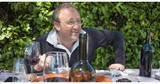
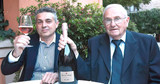
Roberto and Francesco Vezzelli When Francesco Vezzelli established his artisan winery in 1958, most Lambrusco growers were still polyculture farmers who sold their grapes at the local cooperative. If they made wine, it was only for friends and family.But beginning in the 1960s, more and more of the best growers began to estate-bottle their traditional wines, and today, fine authentic small-farm Lambrusco heads every list of the gastronomic treasures of Emilia-Romagna. Francesco’s son Roberto Vezzelli continues the work begun by his father, farming 16 hectares of vines on the mid-slope of the hills outside of Modena.

Terres de Fagayra

Terres de Fagayra

winegrowers Greg Moore

Marjorie and Stéphane Gallet in Montner “Old vines, old soil. I’m the only young thing at the domaine,” Marjorie told an interviewer shortly after she created Domaine Le Roc des Anges in 2001. She was twenty-three.The estate grew to international fame in the hands of this “prodigy.” In 2008 she was joined by her husband, Stéphane, who had been working at the Mas Amiel, a famous producer of Maury. Together they created the tiny “Terres de Fagayra” to produce beautiful, rare bottlings of fortified wines under the appellation, Maury.

Domaine Cornu-Camus

Domaine Cornu-Camus

winegrowers Greg Moore

Lydia Cornu-Camus and Christophe Pertuzot Classic, real-world-priced, estate-bottled Burgundy is always a happy surprise. The land is expensive, the climate is unreliable, and demand usually exceeds supply. But if you’re willing to look beyond the famous villages on the Route des Grands Crus, there are still discoveries to be made: expressive Burgundies, white and red, grown by passionate stewards of the genuine Burgundian tradition. The Cornu family has lived in Echevronne, about seven kilometers northwest of Beaune, since the thirteenth century. Pierre Cornu joined his parents in the late 1970s, and like so many of the best of his generation, was the first in his family to estate-bottle the wine. In 1981 he married Bernadette Camus, and in 2007, after completing her studies in enology at Beaune, their daughter Lydia, along with her husband Christophe Pertuzot (previously of Domaine Leroy), joined them as co-gerants, ensuring the continuity of this dynamic ten-hectare estate.

Poggio Al Sole

Poggio Al Sole

winegrowers Greg Moore

Johannes and Kathrin Davaz There are eighteen contiguous hectares of sloping schistose clay that include the highest vineyards in Chianti, all perfectly sheltered from the Tramontane (north wind) by the surrounding oak forest. In addition to Solaia and Tignanello, neighbors include Fontodi, Castello dei Rampolla, and Villa Caffaggio. Documents in the archives of the abbey of Badia a Passignano, which owned Poggio al Sole until the 1960s, show that olives and wine were grown there as early as the 12th century. Johannes “Giovanni” Davaz was a newly minted enologist when his family bought the estate and he moved there in 1990.

Bele Casel

Bele Casel

winegrowers David Moore

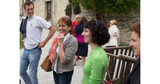
Luca Ferraro, his mother, Antonella, his sister, Paola, and his wife, Giulana Danilo Ferraro set out with the goal of producing fine, estate-bottled Prosecco in the early 1980s when he was an oenology student. His father-in-law had a hectare of old Glera (the grape that used to be known as Prosecco) and Malvasia, and sold the wine in in demijohn to locals.  After completing his studies, Danilo went to work at a nearby distillery, and helped his father-in-law in the vineyard in his spare time. He soon realized that Prosecco was the “heart and soul” of the Colli Asolani, and set out to establish what has become the leading estate in the region.  When we met him, his tiny winery was about the size of an American, two-car garage–producing the best Prosecco we’d ever tasted. Today Danilo continues the work with his son Luca, who oversees the organic farming of their vineyards…and the winery is a little larger, just off of the family home. Here's an Italian television

Château Viella

Château Viella

winegrowers Greg Moore

Alain Bortolussi and his family in Madiran In 1952, Alain Bortolussi's grandfather, an immigrant from the Veneto, purchased the eighteenth-century château and the surrounding 25 hectares of vines, which had just been classified under AOC regulations as Madiran and Pacherenc du Vic Bilh. At the time, it had almost no value. Over the next thirty-five years, most of the estate was replanted with the best clones of Tannat and Cabernet Franc for the Madiran, along with a tiny one-hectare parcel of local white varieties for the Pacherenc du Vic-Bilh. Alain, who is the first to bottle wine at the estate, took charge in 1991. When we met him in 2013, he was just completing the restoration of the château. In 2016, his daughters, Claire, and Marion, joined Alain at Château Viella, and in 2019, on Alain’s nominal “retirement,” have taken the reins of this jewel of a winegrowing estate.

Château Sipian

Château Sipian

winegrowers Greg Moore

Frédéric Méhaye The estate lies on a privileged location: atop a rare mound of Garonnaise gravel, looking directly down on the Gironde estuary. Château Sipian had always been classified a Cru Bourgeois of the Médoc, until the vineyards were pulled up and abandoned in the 1950s. Bernard and Nicole Méhaye purchased the estate in 1978, and planted the first seven hectares of Merlot. But the real history of Château Sipian begins with their son Frédéric, whose risk-taking vision and hard work have lifted the estate into the front rank of Médoc producers. Today, Frédéric’s son, Quentin Méhaye, has taken over responsibility for much of the work in the twenty-five hectares of mostly 30-year-old vines.

Agricola Ca’ La Bionda

Agricola Ca’ La Bionda

winegrowers Greg Moore

Alessandro Castellani in the Casal Vegri vineyard Ca’ La Bionda was founded in 1902 by Pietro Castellani, Alessandro’s great grandfather, who was a passionate grape grower and winemaker. The east facing hillside vineyards extend over 29 hectares in the commune of Marano di Valpolicella, northwest of Verona, in the heart of the Valpolicella Classico zone. Only traditional varieties, including Corvina Veronese, Corvinone, and Rondinella are grown (there are no international varieties), and the farming is entirely organic. Particular attention and care are given to the delicate process of drying the grapes for the production of the Amarone and the sweet Reciotto.

Mas de Libian

Mas de Libian

winegrowers Greg Moore

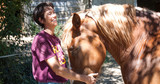
Catherine Thibon and Nestor Jean-Pierre Thibon’s family has operated the Mas de Libian in Saint-Marcel d’Ardèche since 1670. He and his cardiologist wife, Jacqueline, have three daughters: Hélène, Catherine, and Cécile. In 1995, Hélène, Catherine, and Hélène’s husband Alain Macagno assumed responsibility for viticulture and winemaking, and began to estate-bottle the wine, rather than sell it in bulk to négociants. Long before it was fashionable, the Mas de Libian was an organic farm, and in 2005 Hélène introduced the demanding practice of biodynamics. Catherine does much of the vineyard work herself, with the help of “Nestor,” a charming Comptois draft horse who is encouraged by his canine stable mates “Sophia” and “Éclair.”

You are currently shopping in the store!

If you want to shop from one of our other locations shown below, your current shopping cart will be cleared - you may only shop and checkout from a single location at a time.

Select Your Location

Please choose the store below which best suits your interests. Thank you for visiting!

For in-store pickup from our Pennsauken, NJ shop (10 minutes from Center City Philadelphia), or delivery to New Jersey addresses.

For in-store pickup from our Wilmington, DE shop.

For delivery to your door in NY, PA, DC, CT and 32 additional states, or in-store pickup from our Industry City Brooklyn shop.