Moore Brothers Blog

Moore Brothers Blog: Meet the Winegrowers

Vins Talmard

Vins Talmard

winegrowers Greg Moore

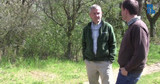
Benjamin Gonçalves and Mallory Talmard The Talmards have grown vines in the Mâconnais since the 17th century, though the current domaine dates only to 1971, when Paul Talmard withdrew from the local cooperative to estate bottle his own wine. In 1997 he was joined by his daughter Mallory and her husband Benjamin, who now farm 27 hectares in the villages of Uchizy, Montbellet, Chardonnay, Tournus, and Farges-lès-Mâcon. Most of the vineyards grow on well-exposed, steep limestone hillsides, which minimize the yields, and maximize concentration and quality. The grapes are fermented and matured on their lees for two to three months in stainless-steel tanks (there is no wood at Cave Talmard), and the wine is bottled in the spring after the harvest.
Weingut Ratzenberger

Weingut Ratzenberger

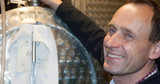
Jochen Ratzenberger in the cellar (photo: Greg Moore) Weingut Ratzenberger is in the beautiful town of Bacharach-Steeg on the left bank of the Rhine, about a half-hour from the Frankfurt airport. It’s our favorite first stop in Germany. The guest apartment is one of the most comfortable places we stay, with the view through the bedroom window dominated by a wall of Pinot Noir (Spätburgunder) vines marching up the towering Steeger St. Jost. Nowhere does Riesling more eloquently describe its home: the hill that the Romans called "Bacchi Ara," the altar of Bacchus (Bacharach). The “Altar of Bacchus” — the view of Bacharach from across the Rhine (photo: Greg Moore)

Diebolt-Vallois

Diebolt-Vallois

Jacques Diebolt in his tiny office When I was first invited to pour this creamy Champagne Blanc de Blanc at George Perrier’s Le Bec-Fin in Philadelphia, I was admitted into a very privileged club: sommeliers at restaurants like Marc Meneau’s L’Espérance in Père-sous-Vézelay, and Gerard Vié’s Les Trois Marches in Versailles. At the time, there were only six hectares of vines, all on the southeast-facing slope below Cramant, which meant there was very little wine available. Even private customers, who drove to Cramant from Paris or Brussels after tasting the wine in a Michelin-starred restaurant, were often disappointed to find nothing for sale at Diebolt-Vallois. More became available when Diebolt acquired vineyards in Chouilly and Le Mesnil-sur-Oger (“putting the family in debt for 100 years,” he chuckles). But more supply only attracted more sommeliers, including Eric Beaumard, the 1992 Meilleur Sommelier de France, and t

Working the Soils in Organic Winegrowing

Working the Soils in Organic Winegrowing

Meet the Winegrowers David Moore

Treating esca, organically, Here's Greg Moore and Peter Fischer of Château Revelette discussing the importance of organic farming in winegrowing. It's a good thing to let some weeds and wildflowers to grow among your vines - this attracts other life to the vineyards, helping to maintain balance. It's also a good idea to cut these weeds and flowers so that they can return natural nutrients to the soil.

With Climate Change, In Some Vineyards, Only A Tractor Will Do.

With Climate Change, In Some Vineyards, Only A Tractor Will Do.

greg Greg Moore

When climate change effects the replanting of vineyards Climate change plays a part in Germany. It used to be that the Ratzenbergers could count on frosts in winter, which help break up soils in the spring. It hasn't happened in a number of years now, so out comes the tractor. Jochen Sr. and Jochen Jr. explain to Greg what's happening.

Isole e Olena

Isole e Olena

"Tuscany's strength, like that of any wine producing region, lies in the typicity of the wines, the unique characteristics that make the wines undeniably Tuscan," says Paolo De Marchi. Since the 1970s when he took the reigns of his family's estate in Tuscany, Paolo has become a leader in the evolution of modern Chianti. When asked about all of the changes that have taken place in his region he points out that, “Tradition, doesn't mean always making the same thing. Tradere from Latin–transport and deliver–we take the best from the past, add our current knowledge, and we prepare the way for those who will come after. We have to face the future, but with a solid foundation in where we come from in order to know where we want to be tomorrow. My focus on Sangiovese recognizes the connection, the ‘genetics’ of Tuscany.” Paolo on the evolution of modern Chianti (part 1) Paolo on the evolution of modern Chianti (part 2) Paolo on the evolution of modern Chi

Corzano e Paterno

Corzano e Paterno

Aljoscha Goldschmidt When Swiss architect Wendel Gelpke bought Corzano in the early 70s, he promised the Marchese Ippolito Niccolini that his run-down seventy-hectare estate would remain intact forever. He made the same covenant with the Marchesa Rangoni-Machiavelli, when he bought her Fattoria di Paterno. Together, they form a 140-hectare estate that produces some of the finest olive oil, sheep’s milk cheeses, and wine in all of Tuscany. A member of Wendel Gelpke’s family manages every activity, including the holiday rental of the beautifully restored farmhouses and apartments. Aljoscha Goldschmidt, who is the managing agronomist and winemaker, is Wendel Gelpke’s nephew. Aljoscha tells his story

Bérèche Pere et Fils

Bérèche Pere et Fils

Raphaël and Vincent Bérêche The original Bérêche estate is centered around 2.5 hectares of vines established by Leon and Albert Bérêche in 1847. Successive generations expanded the property, and today there are a total of 9.5 ha in and around the communes of Craon de Ludes, Ormes, Trépail, and Mailly, all in the Montagne de Reims, as well as the area around Mareuil-le-Port on the left bank of the Marne. The 0.15 ha Mailly parcel, acquired in 2012, is their first Grand Cru vineyard. Since joining their father Jean-Pierre in 2004 and 2008 respectively, Raphaël and Vincent Bérêche have risen to the head of the class of Champagne’s corp of elite grower producers. Most of their wines are sold directly to private customers, who drive from Brussels and Paris and London to pick up their six or twelve bottle allocations at the winery in Craon de Ludes. Almost all the rest goes to Michelin-starred, like Gérard Boye

You are currently shopping in the store!

If you want to shop from one of our other locations shown below, your current shopping cart will be cleared - you may only shop and checkout from a single location at a time.

Don't Change Store

Select Your Location

Please choose the store below which best suits your interests. Thank you for visiting!

New Jersey Pickup & Shipping to NJ

For in-store pickup from our Pennsauken, NJ shop (10 minutes from Center City Philadelphia), or delivery to New Jersey addresses.

Delaware In-Store Pickup

For in-store pickup from our Wilmington, DE shop.

NEW YORK/DIRECT SHIPPING Pickup & Shipping to 36 states

For delivery to your door in NY, PA, DC, CT and 32 additional states, or in-store pickup from our Industry City Brooklyn shop.