null
888-686-6673 888-686-6673
844-305-5023 844-305-5023
877-316-6673 877-316-6673
Moore Brothers Blog

Moore Brothers Blog

Domaine Etienne Daulny

Domaine Etienne Daulny

winegrowers Greg Moore

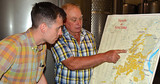
Etiènne Daulny showing the map of his vineyards to Terry Moore If you ask Bertrand Daulny, the winemaker and chef de cave at this impeccable 15-hectare estate in Verdigny, why his elegant Sancerres are always counted among the finest white wines of the middle Loire Valley, he’ll point you to his older brother Etiènne, who grows the grapes. “Il s’agit de la vigne; pas de la cave.” (“It’s all about the vineyards; not about the cellar.”) But if you ask Etiènne, he’ll point you right back to Bertrand. “We grow healthy grapes, but Sauvignon Blanc is a capricious variety, with aromatics that depend on great cellar work.”

Domaine Combier

Domaine Combier

winegrowers Greg Moore

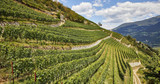
Ghislaine and Laurent Combier Maurice Combier purchased the Domaine's original 10 hectares of vines north of Pont-de-l'Isère in 1962. During the 1960s, he had an allergic reaction to a chemical used in fruit orchards and vineyards to fight plant diseases. In an experiment, he adopted organic farming in half of his property to learn the processes necessary to keep the fruit healthy, naturally. By the 1980s, the entire estate was transformed to organic farming, and the family sold their fruit to the cooperative at Tain l'Hermitage. In 1990, when son Laurent finished oenology school, they left the cooperative and have made their own distinctive style of Crozes-Hermitage ever since. Certified biodynamic farming, low yields, hand-harvesting,and rigorous selection are at the heart of his graceful wines.

Azienda Agricola Kuenhof

Azienda Agricola Kuenhof

winegrowers David Moore

Peter and Brigitte Pliger began producing wines under the Kuen hof name in 1990. Their six hectares of land–located just outside the town of Bressanone, a short distance from the Austrian border–have been in the family for two hundred years and planted to vines since the twelfth century.Perfectly situated at 600 meters above sea level for the traditional varietals, Veltliner, Sylvaner, Riesling and Traminer, the schisty soils produce nuanced, lengthy, highly aromatic wines. The term, Eisacktaler, is the German name for this former Austrian region known as the Valle Isarco in Italian.Peter practices his own form of sustainable agriculture, combining organic and bio-dynamic principles along with his Zen training to find the best mix for each growing season's need. The winemaking is geared towards preserving the vibrant minerality and structure his soils provide resulting in wines that are completely dry, with a complelling richness and complexity. His total production is fewer than 3,000

Chateau Martinat

Chateau Martinat

winegrowers Greg Moore

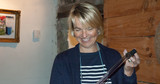
Lucie Donze in her cellar Lucie & Stéphane Donze are the owners of this small estate in the Côte de Bourg. Both were successful in their respective businesses; Lucie was a landscape architect, and Stéphane was in maritime transport. In 1994 they bought the old vineyards and run-down farmhouse of Chateau Martinat with borrowed money. Three years of planning went into the career change. There are only about 24 acres (American) under vine. These hold the Merlot and Cabernet vines which were planted in the late nineteen fifties. The Malbec plantings are much older. The farming is “Lutte Raisonée,” with grass between the rows, and the harvests are by hand.

Paolo’s Pentagon

Paolo’s Pentagon

wine David Moore

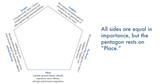
Paolo DeMarchi is one of the most important wine producers in Italy. He is one of a handful of thoughtful growers who were key "inventors" of modern Chianti. Imagine the challenge of redefining a very old (and at the time, sleepy) wine region. Most wine sold here had to be sold in wicker-basket-bottles because novelty trumped quality. To this day, there are those who think of Chianti as thin, skeletal wine, with a handy empty bottle, useful for holding a candle. But in the seventies, when Paolo came of age, he and a few others recognized that the entire area had to be reorganized with a view towards quality over quantity. Just as important, there had to be a respect for tradition, or else the raison d'être would disappear–there would be nothing distinctive about the wines, and the wine-producing economy risked collapse. We often speak about “Old World” wines as being an encapsulation, if you will, of a small region's cultural, and agricultural evolution; less “product”

Domaine Ampeau

Domaine Ampeau

winegrowers Greg Moore

Michel Ampeau in Meursault (photo: Greg Moore) The story we heard was that Robert Ampeau once turned away a swaggering Michelin three-star chef who arrived unannounced to taste wine. But we'd also heard stories of the five incredible cellars under the rue du Cromin, and that Robert’s son Michel was funny and smart. Meeting the Ampeaus was an epiphany, and the the stories about Robert and Michel Ampeau “holding back the wines until they was ready to drink” weren’t true at all. They simply didn’t care whether or not anyone bought them, as much as they cared about the weather, and the vines, and their annual struggle with nature to produce them.

Weingut Weegmüller

Weingut Weegmüller

winegrowers Greg Moore

Steffi with Hans-Günther SchwarzFounded in 1685, Weingut Weegmüller is the oldest winegrowing estate in the Pfalz, older even than the big “three Bs” (von Bassermann-Jordan, von Buhl, and Bürklin-Wolf). Gaby and Stefanie Weegmüller represent the eleventh generation of winegrowing Weegmüllers in Neustadt. There are sixteen hectares of vines, with parcels in all of the best vineyards in the villages of Haardt, Gimmelding, Neustadt, and Mußbach.Founded in 1685, Weingut Weegmüller is the oldest winegrowing estate in the Pfalz, older even than the big “three Bs” (von Bassermann-Jordan, von Buhl, and Bürklin-Wolf). Gaby and Stefanie Weegmüller represent the eleventh generation of winegrowing Weegmüllers in Neustadt. There are sixteen hectares of vines, with parcels in all of the best vineyards in the villages of Haardt, Gimmelding, Neustadt, and Mußbach.When Steffi took over winemaking responsibility from her father in 1984, she had an enviable advantage: a close, familial friendship with

Anna Maria Abbona

Anna Maria Abbona

winegrowers Greg Moore

Anna Maria Abbona and her family in Dogliani If there is any producer in Dogliani who perfectly embodies the idea of stewardship of her heritage, it is Anna Maria Abbona. She was working as a successful graphic designer in 1989 when her father told her that he was ready to retire and sell his vineyards, some of them planted in the 1930s by her great grandfather. Anna Maria couldn’t bear to see her roots and traditions abandoned, so as a determined young woman with school-age children, she returned to the farm with her architect husband, Franco Schellino. Her vineyards are the highest in Dogliani, and are perfectly suited to the classic style of Dolcetto that has reemerged in the last decade: violet colored, moderately tannic, deeply satisfying wine to drink with food. Today, Anna Maria Abbona leads the elite of Dogliani.

Kathryn's Rack of Lamb

Kathryn's Rack of Lamb

favorites Kathryn Schockor

Kathryn’s Rack of Lamb 2) 2-pound racks of lamb, trimmed 6) cloves of garlic, finely minced 2) tablespoons fresh rosemary leaves, finely minced 4) tablespoons extra virgin olive oil     Sea salt     Freshly ground black pepper Place the lamb racks fat side up on a large rimmed baking sheet. Combine the minced garlic and rosemary with the olive oil. Rub the garlic-rosemary mixture all over the lamb. Season with salt (to taste) and let stand at room temperature for 1 hour. Preheat the oven to 450°. Roast the lamb in the upper third of the oven for 25 minutes for medium-rare meat; 30 minutes for more well done meat. Transfer the lamb to a cutting board, tent loosely with foil, and let rest for 10 minutes. Carve the racks between the rib bones and transfer to plates. Season with black pepper, if desired, and serve immediately.

In Memoriam: Gianni Piccoli

In Memoriam: Gianni Piccoli

winegrowers Terry Moore

Gianni Piccoli in 2018 (photo: Terry Moore) We are sad to share with you the news of the passing of Gianni Piccoli, the founder of Corte Gardoni. Agronomist, viticulturist, winemaker, and passionate defender of authenticity, Gianni Piccoli’s beautiful wines have been prominently featured at Moore Brothers for more than two decades. You probably know them yourself. More than that, he was our dear friend. And no one at Moore Brothers was closer to Gianni than my friend and colleague, Joe DiLuzio, who would receive a bi-weekly phone call at the shop from Gianni to chat about current events, gossip about his neighbors, and either celebrate or lament a recent performance by his beloved squadra di calcio, AC Milan. If one of us answered the New Jersey store phone to a poor connection and a raspy voice on the other end asking, “c‘é Giuseppe?” we knew who was calling. “Ironically, my first encounter with Gianni was very inauspicious — twenty years ago at a gathering of French and I

You are currently shopping in the store!

If you want to shop from one of our other locations shown below, your current shopping cart will be cleared - you may only shop and checkout from a single location at a time.

Select Your Location

Please choose the store below which best suits your interests. Thank you for visiting!

For in-store pickup from our Pennsauken, NJ shop (10 minutes from Center City Philadelphia), or delivery to New Jersey addresses.

For in-store pickup from our Wilmington, DE shop.

For delivery to your door in NY, PA, DC, CT and 32 additional states, or in-store pickup from our Industry City Brooklyn shop.